
Some links on this page are affiliate links. If you sign up through one, TradeStackLab earns a commission at no extra cost to you. We only recommend tools we’d actually use on a job, and a commission never buys a better review.
Why Most Plumbers Undercharge (and Don’t Know It)
If you’ve ever finished a job, cashed the check, and still felt like you came up short, you’re not alone. Pricing is the part of running a plumbing business that nobody teaches you. You learn the trade. Nobody sits you down and explains how to cover your actual costs and still make money.
This guide gives you a straightforward formula. It’s not complicated. But you have to be honest with your numbers, or none of it works.
The Core Formula
Every plumbing quote should cover four things:
- Labor costs — what it actually costs you to put a tech on the job
- Material costs — what you paid for parts, plus a markup
- Overhead — your share of the costs of running the business
- Profit margin — the money left over after all of the above
Written simply:
Job Price = Labor + Materials + Overhead Allocation + Profit
Let’s go through each one.
Step 1: Know Your Real Labor Cost
Your labor cost is not the hourly wage you pay a plumber. It’s higher than that. When you add up payroll taxes, workers’ comp, health insurance, paid time off, and any other benefits, your actual cost per hour is usually meaningfully higher than the base wage.
Figure out your fully burdened labor rate for each person on your team. If you’re a solo operator, do the same math for yourself — including what you’d want to pay yourself as the owner doing the work.
Then estimate how many billable hours the job will take. Be realistic. Include drive time if you’re absorbing that cost, time to get materials, and any cleanup. New plumbers routinely underestimate job hours. If you’re not sure, track your time on the next ten jobs and build a reference.
Labor cost for the job = Burdened hourly rate × Estimated hours
Step 2: Price Your Materials Right
Never pass materials through at cost. You’re sourcing them, stocking them, managing them, and taking the risk if something is wrong. A markup is standard and expected.
Common practice in the plumbing trade is to mark up materials somewhere between 20% and 50%, depending on the item. High-volume consumables like fittings might sit lower. Specialty fixtures or equipment might go higher. What’s right for you depends on your supplier relationships and your local market.
The key habit: build your material list before you quote, not after. Guessing at material costs is where a lot of money gets left behind.
Material charge = Your cost × (1 + markup percentage)
Step 3: Allocate Overhead to Every Job
This is the step most small operators skip, and it’s why they feel broke even when they’re busy.
Overhead is everything it costs to keep your business running that isn’t tied to a specific job. Think:
- Vehicle payments, insurance, and fuel
- Office or shop rent
- Software subscriptions (scheduling, invoicing, accounting)
- Phone, internet, advertising
- Tools and equipment depreciation
- Licensing fees, insurance premiums
- Any admin or office staff wages
Add all of that up for the year. Divide it by the number of billable hours you realistically expect to produce in a year. That gives you an overhead rate per billable hour.
Overhead rate per hour = Total annual overhead ÷ Annual billable hours
Then multiply that rate by the estimated hours for the job to get the overhead allocation for that quote.
Be conservative with your billable hour estimate. If you assume 2,000 billable hours but actually only bill 1,400, you’re undercovering your overhead on every single job.
Recommended Gear
Affiliate Link
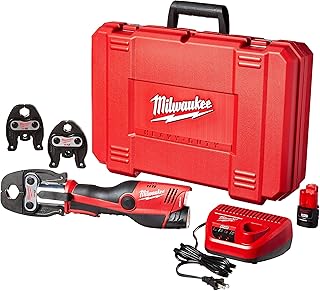
Milwaukee 2473-22 M12 Force Logic Press tool 1/2″ – 1″ Kit
4.5★ (389 reviews)
The article flags tool depreciation as a real overhead line item — a press tool like this one belongs in that annual cost calculation, not treated as a one-time expense you forget to recover.
Step 4: Add a Profit Margin
Covering costs is not the same as making money. Profit is what lets you buy better equipment, weather a slow month, and eventually grow or sell the business. It’s not a bonus — it’s part of the price.
A common approach is to add a profit percentage on top of your total cost (labor + materials + overhead). What that percentage should be varies by market, competition, and the type of work. Residential service calls often run differently than large commercial projects.
Don’t let fear of losing a job push your margin to zero. If you’re winning every quote, you’re probably priced too low.
Final price = (Labor + Materials + Overhead) ÷ (1 − desired profit %)
Note: dividing by (1 − margin) rather than multiplying gives you a true margin percentage, not just a markup. There’s a difference. A 20% markup is not a 20% margin.
Flat-Rate vs. Time and Materials
You have two main ways to present a price to a customer.
Time and Materials (T&M)
You charge your hourly rate plus the cost of materials as the job progresses. Straightforward for unpredictable work — like opening up a wall and finding a mess. The downside is customers get nervous not knowing what the final number will be.
Flat-Rate Pricing
You quote a fixed price for the job upfront. Customers tend to prefer this because they know what they’re paying. You take on the risk if the job runs over, but you also keep the difference if you finish faster. Flat-rate pricing works best for well-defined, repeatable jobs — water heater installs, faucet replacements, drain clearing.
Many plumbers use a flat-rate book or software to standardize their pricing. This removes the temptation to discount on the fly and makes quoting faster. If you’re doing flat rate, your prices still need to be built on the same cost foundation described above — you’re just packaging it differently for the customer.
Recommended Gear

Affiliate Link
Milwaukee Electric – M18 Short Throw Press
4.5★ (194 reviews)
At $799, this is the kind of specialty equipment purchase the article’s overhead formula exists to justify — spread across billable hours, it’s a smaller number than it looks on the invoice.
A Quick Example
| Cost Component | Calculation | Amount |
|---|---|---|
| Labor (3 hours × $55 burdened rate) | 3 × $55 | $165 |
| Materials ($120 cost × 1.35 markup) | $120 × 1.35 | $162 |
| Overhead (3 hours × $30/hr rate) | 3 × $30 | $90 |
| Total Cost | $417 | |
| Profit margin (20% true margin) | $417 ÷ 0.80 | $521 |
| Final Quote | $521 |
These are illustrative numbers. Your burdened rate, overhead rate, and markup will be different. The structure is what matters.
Common Pricing Mistakes to Avoid
- Pricing by gut feel or what a competitor charges. You don’t know their cost structure. Their number might be wrong too.
- Forgetting overhead. It feels invisible, but it’s real money going out the door every month.
- Not tracking job time. If you don’t know how long jobs actually take, your estimates will keep missing.
- Discounting to win work. Occasionally makes sense. As a habit, it just means you work harder for less.
- Quoting from memory on material costs. Prices change. Check the current price before you quote.
How Software Can Help
Doing this math manually every time gets old fast. Field service management software can speed up quoting, track job costs against estimates, and give you a clearer picture of whether you’re actually making money on different job types.
Tools like Jobber let you build quotes with line items, track materials, and send professional-looking estimates from your phone. Housecall Pro has similar quoting features and is popular with plumbing and HVAC shops. Larger operations sometimes move to ServiceTitan, which has more robust job costing reporting — though it comes with more complexity and cost to match.
Software won’t fix bad pricing, but it will make consistent pricing easier to maintain once you’ve done the underlying math.
Recommended Gear

Affiliate Link
RIDGID 36475 Exposed Ratchet Threader Set, Model 12-R Ratcheting Pipe Threading Set…
4.7★ (135 reviews)
The article mentions tools and equipment depreciation as overhead most small operators skip pricing in — a threading set you use across dozens of jobs is exactly what that line item is meant to capture.
Review Your Prices Regularly
Your costs in 2026 are not the same as they were a couple of years ago. Labor costs go up. Materials fluctuate. Insurance premiums climb. If you set your rates once and never revisited them, you’ve almost certainly been absorbing cost increases without passing them through.
Build a habit of reviewing your overhead numbers and burdened labor rates at least once a year. Adjust your pricing accordingly. Raising prices is uncomfortable. Losing money quietly is worse.
The Bottom Line
Pricing plumbing jobs doesn’t have to be complicated, but it does have to be intentional. Know your labor costs, mark up your materials, cover your overhead, and build in a real profit margin. Write it down, quote consistently, and track how jobs actually come in against your estimates.
That’s the whole system. Most plumbers who struggle with profitability aren’t bad at the work — they just never built a pricing process that actually covers what it costs to run a business.